In-Person event
Open-Source Solutions for Integrated Planning
March 13-14, 2024
In-Person event
Open-Source Solutions for Integrated Planning
March 13-14, 2024
In-Person event
Open-Source Solutions for Integrated Planning
March 13-14, 2024
Summary
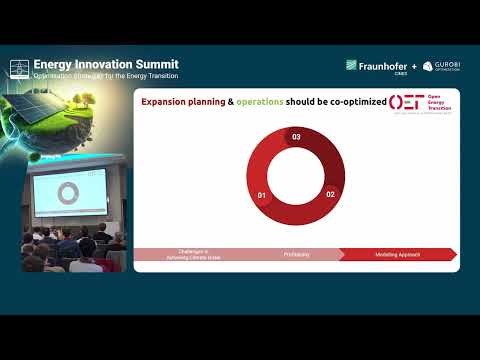
Martha Frysztacki's and Fabian Hofmann's presentation explores the application of optimization strategies in navigating the energy transition, focusing on achieving climate goals while ensuring profitability for stakeholders. The presentation highlights the complexity of renewable energy planning, emphasizing the role of mathematical optimization and open-source tools like PyPSA in addressing these challenges.
To gain deeper insights and access exclusive content, we encourage you to fill out the form and unlock more valuable information.
Challenge
The energy transition presents challenges in balancing climate goals, profitability, and grid stability. Comprehensive planning for renewable energy expansion, transmission, and storage is essential but complex, requiring effective optimization strategies to identify cost-effective solutions amidst evolving technologies and regulatory landscapes.
Solution
Dr. Frysztacki proposes an optimization approach using open-source solutions to tackle energy transition challenges. By formulating energy planning as mathematical optimization problems, stakeholders can analyze scenarios and optimize renewable energy deployment, transmission upgrades, and storage integration. PyPSA, highlighted in the presentation, offers a flexible platform for modeling complex energy systems and exploring diverse optimization strategies.
Results
The presentation demonstrates PyPSA's capabilities in optimizing renewable energy expansion, transmission planning, and storage operations. Through simulations and examples, Dr. Frysztacki illustrates how PyPSA integrates spatially and temporally resolved data to support informed decision-making in energy infrastructure investments. Open-source solutions like PyPSA foster transparency, reproducibility, and collaboration in energy system modeling, crucial for advancing sustainable energy futures.
Dr. Frysztacki concludes by emphasizing the pivotal role of mathematical optimization and open-source tools in guiding the energy transition. By leveraging these tools, stakeholders can address challenges in renewable energy integration, grid stability, and profitability, paving the way for a resilient and efficient energy infrastructure capable of meeting future demands sustainably.
Summary
Martha Frysztacki's and Fabian Hofmann's presentation explores the application of optimization strategies in navigating the energy transition, focusing on achieving climate goals while ensuring profitability for stakeholders. The presentation highlights the complexity of renewable energy planning, emphasizing the role of mathematical optimization and open-source tools like PyPSA in addressing these challenges.
To gain deeper insights and access exclusive content, we encourage you to fill out the form and unlock more valuable information.
Challenge
The energy transition presents challenges in balancing climate goals, profitability, and grid stability. Comprehensive planning for renewable energy expansion, transmission, and storage is essential but complex, requiring effective optimization strategies to identify cost-effective solutions amidst evolving technologies and regulatory landscapes.
Solution
Dr. Frysztacki proposes an optimization approach using open-source solutions to tackle energy transition challenges. By formulating energy planning as mathematical optimization problems, stakeholders can analyze scenarios and optimize renewable energy deployment, transmission upgrades, and storage integration. PyPSA, highlighted in the presentation, offers a flexible platform for modeling complex energy systems and exploring diverse optimization strategies.
Results
The presentation demonstrates PyPSA's capabilities in optimizing renewable energy expansion, transmission planning, and storage operations. Through simulations and examples, Dr. Frysztacki illustrates how PyPSA integrates spatially and temporally resolved data to support informed decision-making in energy infrastructure investments. Open-source solutions like PyPSA foster transparency, reproducibility, and collaboration in energy system modeling, crucial for advancing sustainable energy futures.
Dr. Frysztacki concludes by emphasizing the pivotal role of mathematical optimization and open-source tools in guiding the energy transition. By leveraging these tools, stakeholders can address challenges in renewable energy integration, grid stability, and profitability, paving the way for a resilient and efficient energy infrastructure capable of meeting future demands sustainably.
Summary
Martha Frysztacki's and Fabian Hofmann's presentation explores the application of optimization strategies in navigating the energy transition, focusing on achieving climate goals while ensuring profitability for stakeholders. The presentation highlights the complexity of renewable energy planning, emphasizing the role of mathematical optimization and open-source tools like PyPSA in addressing these challenges.
To gain deeper insights and access exclusive content, we encourage you to fill out the form and unlock more valuable information.
Challenge
The energy transition presents challenges in balancing climate goals, profitability, and grid stability. Comprehensive planning for renewable energy expansion, transmission, and storage is essential but complex, requiring effective optimization strategies to identify cost-effective solutions amidst evolving technologies and regulatory landscapes.
Solution
Dr. Frysztacki proposes an optimization approach using open-source solutions to tackle energy transition challenges. By formulating energy planning as mathematical optimization problems, stakeholders can analyze scenarios and optimize renewable energy deployment, transmission upgrades, and storage integration. PyPSA, highlighted in the presentation, offers a flexible platform for modeling complex energy systems and exploring diverse optimization strategies.
Results
The presentation demonstrates PyPSA's capabilities in optimizing renewable energy expansion, transmission planning, and storage operations. Through simulations and examples, Dr. Frysztacki illustrates how PyPSA integrates spatially and temporally resolved data to support informed decision-making in energy infrastructure investments. Open-source solutions like PyPSA foster transparency, reproducibility, and collaboration in energy system modeling, crucial for advancing sustainable energy futures.
Dr. Frysztacki concludes by emphasizing the pivotal role of mathematical optimization and open-source tools in guiding the energy transition. By leveraging these tools, stakeholders can address challenges in renewable energy integration, grid stability, and profitability, paving the way for a resilient and efficient energy infrastructure capable of meeting future demands sustainably.