In-Person event
Network Expansion and Design Optimization of District Heating Systems utilizing Open Data
March 13-14, 2024
In-Person event
Network Expansion and Design Optimization of District Heating Systems utilizing Open Data
March 13-14, 2024
In-Person event
Network Expansion and Design Optimization of District Heating Systems utilizing Open Data
March 13-14, 2024
Summary
Maximilian Sporleder's presentation on "Network Expansion and Design Optimization of District Heating Systems Utilizing Open Data" delves into the complexities of designing and optimizing district heating networks amidst the energy transition. As a PhD student focusing on the design optimization of supply systems and district heating networks, Sporleder provides an in-depth overview of mathematical optimization techniques. The presentation highlights the importance of using open data and rule-based pre-processing methods to address the challenges of decarbonizing heating systems. To gain deeper insights and access exclusive content, we encourage you to fill out the form and unlock more valuable information.
To gain deeper insights and access exclusive content, we encourage you to fill out the form and unlock more valuable information.
Challenge
Sporleder underscores the pressing need to optimize the design of district heating networks, particularly to incorporate renewable energy sources and seasonal thermal storage systems. Existing networks often rely on fossil fuels, necessitating a shift towards decarbonization and electrification within the heating sector.
Solution
Sporleder proposes a mathematical optimization approach for designing and expanding district heating systems. The methodology involves multi-stage pre-processing steps to estimate demand and determine network topology using open data sources like OpenStreetMap and census data. A rule-based algorithm optimizes network connections based on producer locations and energy density. The optimization process integrates temperatures and mass flows to design the supply system, considering hydraulic optimization, thermal energy storage, and heat pump performance.
Results
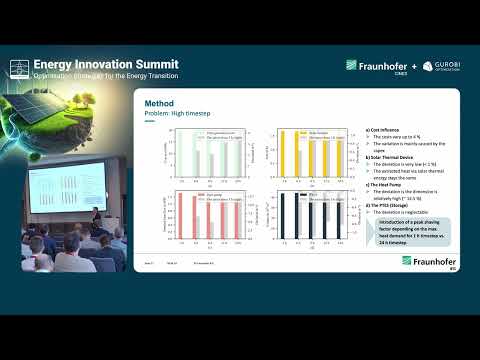
Through a case study in a district in Frankfurt, Sporleder demonstrates the application of the proposed methodology. The optimized supply system includes components such as wastewater heat pumps, thermal energy storage, and solar thermal fields, all within space constraints and investment costs. The presentation highlights the trade-offs in optimizing district heating systems, including the impact of time steps on design accuracy and computation time.
Summary
Maximilian Sporleder's presentation on "Network Expansion and Design Optimization of District Heating Systems Utilizing Open Data" delves into the complexities of designing and optimizing district heating networks amidst the energy transition. As a PhD student focusing on the design optimization of supply systems and district heating networks, Sporleder provides an in-depth overview of mathematical optimization techniques. The presentation highlights the importance of using open data and rule-based pre-processing methods to address the challenges of decarbonizing heating systems. To gain deeper insights and access exclusive content, we encourage you to fill out the form and unlock more valuable information.
To gain deeper insights and access exclusive content, we encourage you to fill out the form and unlock more valuable information.
Challenge
Sporleder underscores the pressing need to optimize the design of district heating networks, particularly to incorporate renewable energy sources and seasonal thermal storage systems. Existing networks often rely on fossil fuels, necessitating a shift towards decarbonization and electrification within the heating sector.
Solution
Sporleder proposes a mathematical optimization approach for designing and expanding district heating systems. The methodology involves multi-stage pre-processing steps to estimate demand and determine network topology using open data sources like OpenStreetMap and census data. A rule-based algorithm optimizes network connections based on producer locations and energy density. The optimization process integrates temperatures and mass flows to design the supply system, considering hydraulic optimization, thermal energy storage, and heat pump performance.
Results
Through a case study in a district in Frankfurt, Sporleder demonstrates the application of the proposed methodology. The optimized supply system includes components such as wastewater heat pumps, thermal energy storage, and solar thermal fields, all within space constraints and investment costs. The presentation highlights the trade-offs in optimizing district heating systems, including the impact of time steps on design accuracy and computation time.
Summary
Maximilian Sporleder's presentation on "Network Expansion and Design Optimization of District Heating Systems Utilizing Open Data" delves into the complexities of designing and optimizing district heating networks amidst the energy transition. As a PhD student focusing on the design optimization of supply systems and district heating networks, Sporleder provides an in-depth overview of mathematical optimization techniques. The presentation highlights the importance of using open data and rule-based pre-processing methods to address the challenges of decarbonizing heating systems. To gain deeper insights and access exclusive content, we encourage you to fill out the form and unlock more valuable information.
To gain deeper insights and access exclusive content, we encourage you to fill out the form and unlock more valuable information.
Challenge
Sporleder underscores the pressing need to optimize the design of district heating networks, particularly to incorporate renewable energy sources and seasonal thermal storage systems. Existing networks often rely on fossil fuels, necessitating a shift towards decarbonization and electrification within the heating sector.
Solution
Sporleder proposes a mathematical optimization approach for designing and expanding district heating systems. The methodology involves multi-stage pre-processing steps to estimate demand and determine network topology using open data sources like OpenStreetMap and census data. A rule-based algorithm optimizes network connections based on producer locations and energy density. The optimization process integrates temperatures and mass flows to design the supply system, considering hydraulic optimization, thermal energy storage, and heat pump performance.
Results
Through a case study in a district in Frankfurt, Sporleder demonstrates the application of the proposed methodology. The optimized supply system includes components such as wastewater heat pumps, thermal energy storage, and solar thermal fields, all within space constraints and investment costs. The presentation highlights the trade-offs in optimizing district heating systems, including the impact of time steps on design accuracy and computation time.